
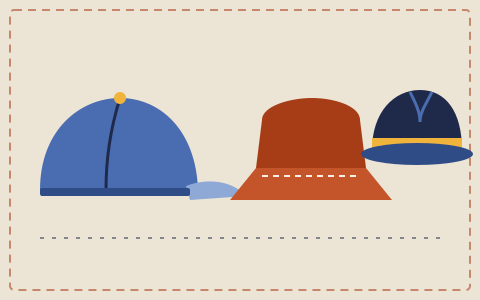
Two parts every hat shares
Encyclopaedia Britannica's entry on hats describes them as head coverings with a crown and, usually, a brim, worn for protection from the weather, for ceremony, to show occupation or rank, and for fashion. That two-part idea is a useful way to understand almost any lid. The crown is the part that covers the top of the head. The brim is whatever sticks out from the bottom of the crown, whether it goes all the way round or only shades the eyes.
A cap is, broadly, a close-fitting head covering with no brim or with a peak only at the front. A hat usually has a brim all round. The words overlap in everyday speech, and this handbook uses "lid" for both. What follows is a parts list and a field guide to the styles readers are most likely to meet. The style names are common usage rather than formal definitions, and you will see the same name used for slightly different shapes.
The anatomy of a cap
A typical peaked cap is built from a handful of parts, each with a name that turns up in care advice:
- Panels. The crown is sewn from triangular or curved panels that meet at the top. Six panels is a common construction; five-panel caps use one wide front panel, which leaves a large flat area at the front.
- Button. A small fabric-covered disc at the top where the panels meet. It hides and reinforces the point where the seams converge.
- Eyelets. Small stitched or metal-ringed holes in the panels that let warm air out.
- Seam tape. Strips of fabric covering the inside seams. They keep raw edges from fraying against your head.
- Front buckram or lining. A stiff backing behind the front panels that makes a cap "structured" and holds the front upright. Unstructured caps leave it out and collapse softly when not worn.
- Peak, bill or visor. The stiff projection at the front. It is usually fabric wrapped around a stiffener insert, which can be cardboard in older or cheaper caps and plastic in many modern ones. This matters for cleaning, as chapter 06 explains.
- Sweatband. The band of fabric sewn inside the bottom edge of the crown. It absorbs sweat and is the part that gets dirtiest.
- Closure. The strap, snap, buckle or stretch band at the back, covered in chapter 01.
The anatomy of a brimmed hat
Felt and straw hats use a slightly different vocabulary:
- Crown and crease. The crown of a felt hat is often shaped with a crease or dents. A centre-dent crown has a single groove down the middle; pinches at the front give a grip point for lifting the hat.
- Brim and brim edge. The brim can be flat, snapped down at the front, or curled up at the sides. Some brims have a bound edge of ribbon; others are raw-cut.
- Hatband. The decorative band around the outside of the crown, often ribbon. It hides the join between crown and brim and is separate from the sweatband inside.
- Sweatband. As on a cap, a band inside the crown, traditionally leather on felt hats and fabric on many others.
- Lining or tip. Some hats have a fabric lining in the top of the crown.
Britannica's entry on felt describes it as a fabric made by matting fibres together rather than weaving them, and notes its long use in hat making. Because felt is formed rather than woven, a felt crown can be blocked into almost any shape with steam and a wooden form, which is why felt hats come in so many crown shapes.
Worked example
An imaginary reader is told their cap "lost its structure" in the wash. Knowing the parts, they can see what happened: the front buckram softened, so the front panels no longer stand up. The panels, peak and sweatband are fine. That points to a fix (drying the front over a rounded form) rather than a write-off.
Common cap styles
| Style | What identifies it | Typical materials |
|---|---|---|
| Six-panel baseball cap | Rounded crown of six panels, button on top, curved or flat peak | Cotton twill, wool blends, polyester |
| Five-panel cap | One wide front panel, often a flatter, lower crown | Cotton, nylon, canvas |
| Mesh-back cap | Solid front panels with open mesh at the sides and back for airflow; often a tall foam-backed front | Polyester mesh, foam, cotton |
| Unstructured low-profile cap | No front stiffener, so it sits close and slouches when off the head; usually a curved peak | Washed cotton, denim, canvas |
| Beanie | Close-fitting knitted cap with no peak, sometimes with a folded cuff | Wool, acrylic, cotton knits |
| Flat cap | Rounded, flat-topped crown pulled forward over a small stiff peak | Wool tweed, cotton, linen |
| Beret | Soft, round and flat-crowned with no peak | Wool felt or knit |
The distressed look this handbook takes its name from is most often seen on cotton and denim versions of the six-panel and unstructured caps, because those fabrics fray and fade in an attractive way. Chapter 04 explains how that look is made.
Common hat styles
- Bucket hat. A soft, round crown with a short brim sloping down all the way round. Usually cotton canvas, denim or nylon, and often packable.
- Fedora. A felt hat with a creased crown, front pinches and a medium brim, typically worn snapped down at the front.
- Trilby. Similar to a fedora but with a shorter brim, often turned up at the back.
- Wide-brimmed outdoor hat. A broad brim all round, often with a chin cord, made from felt, canvas or straw.
- Straw hats. A family rather than a single style. Straw hats are woven or plaited from plant material, from rough boater straw to very fine hand weaving. UNESCO's Representative List of the Intangible Cultural Heritage of Humanity includes the traditional weaving of the Ecuadorian toquilla straw hat, a hand craft using fibre from a palm-like plant that is processed, dried and woven by hand. It is slow, skilled work passed down within families and communities.
Hats change shape and meaning over time, and the same name can describe noticeably different hats in different places and decades. If you are trying to identify an older or unusual hat, the parts list above (crown shape, brim, band and construction) is usually more reliable than the name on a label.
Matching a style to a job
Style choices are personal, but a few practical points apply widely:
- Sun. The CDC's sun safety guidance recommends a hat with a wide brim all round to shade the face, ears and back of the neck, and notes that a baseball cap leaves the ears and neck exposed. A bucket hat or wide-brimmed hat covers more than a cap of the same material.
- Heat. Mesh backs, eyelets and light, breathable fabrics release warm air. A dense felt or a foam-fronted cap holds heat.
- Rain. Felt sheds light rain but loses shape if soaked and dried carelessly. Many straw hats should be kept dry. Synthetic bucket hats dry quickly.
- Travel. Unstructured caps, beanies and soft bucket hats pack flat. Structured caps and felt hats need a crown kept full and a brim kept free of weight.
- Distressed finishes. A ripped or frayed cap is a style choice, not a practical one. Chapter 04 covers how to stop a deliberate rip from becoming an accidental hole.
Next chapter: Hat materials and fibres: what your lid is made of