
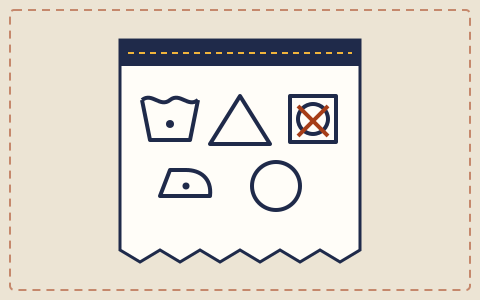
Two different labels
A label inside a hat can carry two kinds of information, and it helps to keep them apart. The first is fibre content: what the fabric is made of. The second is care instructions: how the maker says it can be cleaned. In the United States, these are governed by different rules. The Federal Trade Commission's guide to the Textile and Wool Acts covers fibre content, country of origin and the identity of the maker or seller. The FTC's Care Labeling Rule covers care instructions.
Fibre content tells you what the material is, which helps you predict how it will behave (see chapter 03). Care instructions tell you what the maker has a reasonable basis for saying is safe. When both are present, read both.
What the US care rule requires
The FTC's business guide, "Clothes Captioning: Complying with the Care Labeling Rule", explains the rule in plain terms. Paraphrased, the main points for covered garments are:
- The label must give a regular care instruction: either washing, or dry cleaning, or both if both are safe. One safe method is enough; the maker does not have to list every method that would work.
- The label must warn about any part of the regular care procedure that a consumer could reasonably be expected to use but that would harm the item, such as "do not tumble dry" or "wash separately".
- The maker must have a reasonable basis for the instructions, such as test results or experience with the fabric.
- The label must be permanently attached, easy to find and readable for the useful life of the product.
- Instructions can be written in words, or given with the care symbols of the ASTM standard for care symbols, and words can be added to symbols.
The practical upshot is that a care label is a minimum, not a menu. If it says "hand wash", that is the method the maker stands behind. It does not mean every other method will ruin the item, but it does mean any other method is at your own risk.
Why many hats have no care label
The FTC's guidance explains that the Care Labeling Rule applies to textile wearing apparel, and describes items worn only on the head, hands or feet as outside its scope. In other words, under US rules a hat does not have to carry care instructions, even when a shirt made of the same fabric would. Many hats still carry care labels, and many sold internationally carry them because other markets expect them, but an absent care label on a cap is not a sign of anything wrong.
Fibre content labelling is a separate question and depends on the product and the market, so a hat may carry a fibre label without care instructions, both, or neither.
The five basic symbols
Care symbols are designed to work without words. The American Cleaning Institute's guide to laundry care symbols describes five basic shapes, each standing for one stage of care:
| Shape | Stage of care | Common variations |
|---|---|---|
| A washtub | Washing | A hand in the tub for hand wash; dots for temperature; bars for gentler cycles |
| A triangle | Bleaching | Plain for any bleach; diagonal lines for non-chlorine bleach only |
| A square | Drying | A circle inside for tumble drying; lines for line drying, drip drying or drying flat |
| An iron | Ironing | Dots for the heat setting |
| A circle | Professional cleaning | Letters or marks inside for the dry cleaning or wet cleaning process |
Systems used in different countries share these shapes but differ in some details, and the drawing on a real label can be small and stylised. If a symbol is unclear, it is safer to assume the more cautious reading.
Dots, bars and crosses
The basic shapes are modified in a consistent way:
- Dots stand for temperature or heat. More dots mean a higher maximum temperature for washing, tumble drying or ironing. The exact temperature each number of dots represents is set in the symbol standard, so check a symbol guide rather than guessing.
- Bars under the washtub or tumble-dry symbol mean a gentler cycle: one bar for a permanent press or synthetic cycle, two for a delicate or gentle cycle.
- A cross through any symbol means "do not". A crossed washtub means do not wash; a crossed triangle, do not bleach; a crossed square with a circle, do not tumble dry.
Worked example
An imaginary cotton cap carries four symbols: a washtub with one dot and two bars, a crossed triangle, a crossed tumble-dry square and a crossed iron. Read together: wash cold on a gentle cycle, no bleach, no tumble drying, no ironing. That matches the cautious approach in chapter 06, and the crossed iron is a hint that the peak or a print will not tolerate heat.
A word on temperature
Hot water is rarely needed for hats, and for wool, felt, synthetics and structured caps it adds risk: shrinking, felting, warped stiffeners and softened glues. For hats, the cooler, gentler choice is usually also the safer one.
What to do when there is no label
Because many hats are not required to carry care instructions, you will often have to decide for yourself. A sensible order of reasoning, drawn from general practice:
- Identify the main fabric. Use any fibre label, or the descriptions in chapter 03. If you cannot tell, assume the most delicate likely material.
- Identify the hidden parts. Is the peak card or plastic? Is the sweatband leather? Is there a foam front, a glued patch or a print?
- Choose the gentlest method that will work. Brushing before spot cleaning, spot cleaning before hand washing, hand washing before any machine.
- Test first. Try any cleaner or damp cloth on a hidden area, such as the inside of the sweatband, and check for colour transfer or marking before you go further.
- Avoid heat. No hot water, no tumble dryer, no iron directly on the hat.
The more expensive, older or sentimental the hat, the stronger the case for stopping at brushing and spot cleaning, or for asking a specialist cleaner who handles hats.
Next chapter: Cleaning caps and hats without ruining their shape