
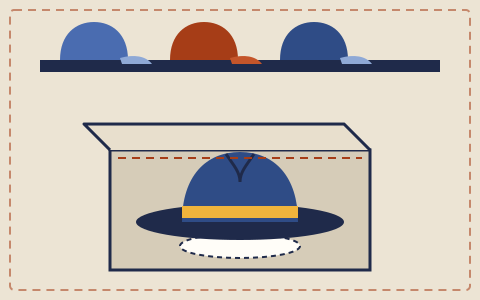
Four things that damage stored hats
Hats spend far more time stored than worn, and most of the damage they suffer happens off the head. Museums think about storage in terms of "agents of deterioration", and the Canadian Conservation Institute's guidance on caring for textiles and costumes is a useful starting point even for everyday hats. For a household, four threats cover most of what goes wrong:
- Crushing and distortion: crowns flattened, brims bent, peaks creased.
- Light: colours fading on the side facing a window.
- Damp: mould, musty smells and stains, especially in sweatbands.
- Pests: clothes moth larvae eating wool and felt.
Dust and dirt make all four worse, so the single most useful habit is to put hats away clean and dry. Chapter 06 covers cleaning.
Keeping the shape
The CCI's textile guidance recommends supporting three-dimensional objects so that their weight is spread and they are not distorted, and padding them with clean, inert materials. Applied to hats, that means:
- Brimmed hats rest on their crown or on a stand, not flat on their brim. A felt or straw hat left brim-down on a shelf takes its weight on the brim edge, which flattens or warps it over time. Upside down on the crown, or on a hat stand or form, the brim carries no load.
- Fill the crown. Loosely crumpled acid-free tissue paper inside the crown keeps it full and holds creases in place. Avoid newspaper, which can transfer ink and is acidic.
- Do not stack brimmed hats. Stacking presses the lower hats' crowns and brims.
- Caps can nest, gently. Structured caps can be stacked one inside another if the crowns match in shape, with the peaks aligned. Do not force a deeper crown into a shallower one.
- Never hang a hat by its brim edge. Hooks and pegs dent the crown and stretch the band. If you hang caps, use a wide, rounded support inside the crown or hang them by the closure strap so the crown hangs freely.
Light and fading
The Canadian Conservation Institute's guidance on light explains that light, and especially ultraviolet radiation, fades dyes and weakens fibres, and that the damage is cumulative and irreversible. A hat on a sunny windowsill fades on one side; a hat on a shelf in a bright room fades slowly all over. Indigo denim and strong reds are often noticeably affected.
- Keep hats away from direct sun and bright windows.
- For hats you display, rotate them now and then so one side does not take all the light, or display them where daylight does not reach.
- For long-term storage, a closed box or a cupboard is darker than any open shelf.
If you like the sun-faded look on a distressed cap, that is a choice, but it is the same process: the fabric is a little weaker where it has faded.
Damp, mould and smells
The US Environmental Protection Agency's guide to mould and moisture is clear that the key to mould control is moisture control: dry damp materials promptly and keep indoor humidity low. For hats that means:
- Never put a hat away damp. After rain or a sweaty day, let it air-dry fully, crown supported, before it goes into a box or bag.
- Avoid damp spaces. Basements, garages and the backs of cupboards against cold outside walls tend to be damp. A cupboard inside the living space is usually better.
- Avoid sealed plastic for damp-prone materials. Plastic traps any moisture that is present. Breathable cotton bags or boxes with some airflow are often recommended for felt and straw, while sealed containers are useful against moths for clean, dry wool (see below). Choose based on which risk is greater where you live.
- Check now and then. A musty smell is an early warning. Air the hat and find the source of damp before mould shows.
Worked example
An imaginary reader keeps a box of winter hats in a garage. In spring one felt hat has pale spots and smells musty. They move the box indoors, let each hat air in a dry room away from sun, brush the felt once it is dry, and in future leave hats out to dry fully before boxing them.
Clothes moths and wool
The University of California's Statewide Integrated Pest Management Program, in its Pest Notes on clothes moths, explains that it is the larvae, not the adult moths, that do the damage, and that they feed on animal fibres such as wool, felt, fur and feathers. They prefer soiled items, such as those stained with sweat or food, and dark, undisturbed places. Wool beanies, felt hats and hats with feather trim are therefore the most at risk, while cotton and synthetic caps are much less attractive to them.
The same publication's prevention advice translates directly to hats:
- Clean before storing. Brushing and cleaning remove the soiling and any eggs or larvae that may be present.
- Store clean wool in tightly sealed containers. Larvae cannot reach what they cannot get into.
- Inspect and disturb regularly. Moths do best in places nobody looks. Taking stored hats out, brushing them and airing them now and then interrupts that.
- Watch for signs. Small irregular holes, bare patches in felt, silken tubes or webbing, and tiny pellets of droppings are signs of activity.
If you find an infestation, the UC IPM publication describes non-chemical and chemical options and their limitations. This handbook does not recommend specific products. For valuable hats, a textile conservator can advise.
Everyday storage for caps
Caps worn every week need less ceremony. General practice that keeps them in shape:
- A shelf where they sit crown-up, side by side, or a row of wide rounded hooks inside the crown, keeps their shape and lets them air.
- Over-door cap racks with clips at the back strap work well for unstructured caps; structured caps keep their shape better on a shelf.
- Do not leave caps in a hot car. Heat can soften synthetic fabrics, foam fronts and glues, and strong sun fades the dashboard-facing side.
- In a bag or suitcase, put a structured cap in last, crown up, and fill it with soft clothes such as socks to protect the crown.
Long-term and seasonal storage
For hats that will be put away for a season or longer, the CCI's guidance points to a few basic conditions: clean items, stable and moderate temperature and humidity, darkness, support for the shape, and clean, inert packing materials. A practical version:
- Clean and fully dry each hat.
- Fill the crown with acid-free tissue; wrap the hat loosely in more tissue or a clean cotton cloth.
- Place it in a box large enough that the brim does not touch the sides, resting on its crown or supported by a ring of rolled tissue.
- Use sealed containers for clean wool and felt if moths are a known problem in your home; otherwise a box with some airflow.
- Label the outside so you do not need to open every box to find a hat.
- Store the box indoors, off the floor, away from heating vents, outside walls and windows.
- Check stored hats every few months for smells, marks and signs of pests.
None of this needs specialist equipment. The aim is simple: keep hats clean, dry, dark and supported, and look at them often enough to catch a problem early.
That is the last chapter. Back to the handbook