
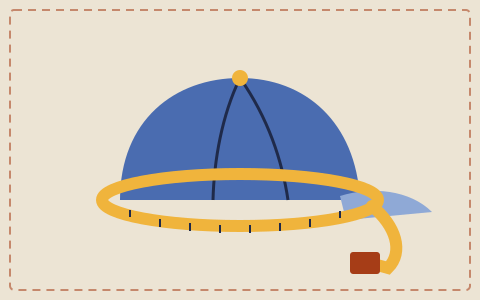
Why fit is mostly about one line
A hat sits on your head along a single ring: the place where the inside band meets your forehead at the front, passes just above your ears at the sides, and wraps around the bulge at the back of your skull. Encyclopaedia Britannica describes a hat as a head covering with a crown, usually with a brim, and the band is where those two parts meet the wearer. Almost every question about fit comes back to whether that ring is the right length and the right shape for your head.
If the ring is too short, the hat perches high, presses on the forehead and leaves a red line by the end of the day. If it is too long, the hat drops towards your eyebrows, spins in the wind and slides when you look down. The depth of the crown, the curve of the peak and the width of a brim change how a hat looks, but they rarely rescue a band that is the wrong size.
This chapter explains how to measure that ring, how sizes are commonly written, and how to judge fit for yourself. Sizing conventions vary from one maker to the next and there is no single standard this handbook can point to, so treat the methods below as widely used general practice rather than rules.
Measuring your head
The measurement that matters is head circumference, taken where the hat will sit. A soft tailor's tape is the easiest tool. If you only have a rigid ruler, a length of string or a strip of paper works: wrap it, mark the overlap, then lay it flat against the ruler.
- Stand in front of a mirror so you can see the tape stays level.
- Place the tape across the middle of your forehead, roughly a finger's width above your eyebrows.
- Run it around the sides, just above the tops of your ears, not over them.
- Take it around the back at the widest point of the skull, which for most people is slightly below the crown of the head.
- Pull it snug but not tight, the way a hat band would sit, and read where the tape meets its starting point.
- Measure two or three times. If the readings differ, use the larger one.
Hair matters. Thick or long hair, braids or a bun at the back all change the measurement, so measure with your hair as you usually wear it under a hat. If you often wear a hat over a hood or a thin under-cap in cold weather, measure that way too, or plan to buy for your largest everyday configuration.
Worked example
An imaginary reader measures three times and gets slightly different readings because the tape slipped at the back once. They keep the largest reading, write it down in both centimetres and inches, and note that they wear their hair tied back. That single note saves guessing later, because every sizing chart they meet starts from the same number.
How sizes are written
Hat sizes are usually expressed in one of three ways, and many labels show more than one:
- Circumference. The head measurement itself, in centimetres or inches. This is the most direct system and the easiest to compare across makers.
- Lettered sizes. Small, medium, large and so on, each covering a range of circumferences. The ranges are set by each maker and overlap differently, so a medium from one source can fit like a large from another.
- Numbered fitted sizes. Traditional fitted hats and some fitted caps use a number with fractions. These numbers are a convention that relates to the size of the head opening, not a measurement you can read straight off a tape. The way to use them is to find the maker's own chart and look up your circumference.
Whatever the system, the safe habit is the same: start from your measured circumference and use the size chart for the specific hat in front of you. If you fall between two sizes, the general advice is to choose the larger one for felt and structured hats, because a band can be padded smaller but cannot easily be made bigger, and to consider the smaller one for knitted hats that will relax with wear.
Fitted, adjustable and stretch caps
Caps solve the sizing problem in different ways, and knowing which kind you have explains why two caps marked the same size can feel quite different.
| Closure | How it adjusts | What to watch for |
|---|---|---|
| Fitted (closed back) | No adjustment; the band is one fixed length | Must match your measurement closely |
| Stretch band | An elastic band built into the crown gives a little | Usually sold as a small range; can feel tight at the top of the range |
| Snap strap | A plastic strip with pegs and holes at the back | Adjusts in steps, so the ideal fit can fall between two holes |
| Strap and buckle | A fabric or leather strap through a metal or plastic slide | Adjusts smoothly; the strap end can fray or stiffen with sweat |
| Hook-and-loop | Two fabric tabs that grip each other | Adjusts smoothly; the hook side can snag knits and hair |
| Drawcord or toggle | A cord through a channel in the band | Common on bucket and outdoor hats; easy to over-tighten |
Adjustable closures change the length of the band, not the shape or depth of the crown. A cap with a shallow crown will still sit high on a head with a deep crown, however the strap is set. If adjustable caps always feel as if they are perched on top, the problem is crown depth, not size.
Judging fit in the mirror
A measurement gets you close; your head and the mirror decide. These checks are general practice and apply to most caps and brimmed hats:
- The band touches all the way round. There should be light, even contact at the forehead, sides and back, with no gap at the temples and no hot spot at the forehead.
- One finger fits under the band. If you can slide a finger between band and forehead without forcing it, the fit is comfortable. If you can fit two easily, it is probably loose.
- It stays put when you look down. Tilt your head forward as if reading. A hat that slides forward is too big; one that pops up at the back is too small or too shallow.
- The brim or peak sits level. A peak that tips up or down when the band is properly seated usually means the crown shape does not suit your head.
- No marks after ten minutes. Wear it around the house. A red line or a headache means the band is too tight, whatever the label says.
Fit is also about what the hat is for. The CDC's sun safety advice notes that a baseball cap shades the front and top of the head but leaves the ears and the back of the neck exposed, while a hat with a brim all the way round shades the face, ears and neck. If sun is the reason you are choosing a hat, the style can matter as much as the size.
When materials change the fit
The material a hat is made from affects how its size changes over time. The next chapters cover materials in more detail, but three points matter for fit:
- Wool and felt can shrink. Britannica explains that wool fibres have scaly surfaces that lock together under moisture, heat and movement, which is how felt is made in the first place. The same process can continue in a hat that is soaked, heated or scrubbed, tightening the band.
- Knits relax. A knitted beanie usually stretches a little with wear. A snug knit at first is often comfortable after a few days.
- Sweatbands change. A leather or fabric sweatband can stiffen, shrink slightly or soften with sweat and drying. This is one reason a hat can feel different after a hot summer.
Small adjustments that help
If a hat is only slightly too big, a thin strip of foam or felt tucked behind the sweatband, often sold as sizing tape, takes up space without changing the outside of the hat. Placing it at the front and back rather than the sides keeps the hat sitting level. This is a common and easily reversed fix.
A hat that is too small is harder. Stretching a felt or straw hat involves steam and a stretching tool and can distort or split the material, so it is a job many people leave to a hat maker or simply avoid. Stretching a cotton cap by soaking it and drying it on a slightly larger rounded form sometimes gives a little extra room, but it can also distort the peak and loosen the stitching. The safest choice remains buying the right size in the first place.
In one line
Measure where the hat sits, keep the largest reading, use the chart for the hat in front of you, and let the mirror have the last word.
Next chapter: Cap and hat styles, and the names of their parts